Why This Is the Most Important Curriculum Update of 2026–27
India’s schools are at an inflection point. The National Education Policy (NEP) 2020 has set an ambitious goal: make India a global leader in Artificial Intelligence, Machine Learning, Data Science, and Computational Thinking. And now, CBSE has translated that policy into action with its official Computational Thinking and Artificial Intelligence (CT & AI) Curriculum for Classes 3 to 8, released for Academic Year 2026–27.
This is not an elective. This is not a pilot. This is mainstream CBSE curriculum — aligned with NCF-SE 2023 — now embedded into Mathematics, Science, and Social Studies from Grade 3 onwards, and evolving into dedicated AI literacy from Grade 6.
The Big Picture: What CBSE Is Actually Mandating
The curriculum is built around one core idea: Computational Thinking (CT) is the intellectual backbone of AI. You cannot teach students AI meaningfully unless they first develop the ability to decompose problems, recognize patterns, think algorithmically, and apply abstraction. The CBSE curriculum builds this foundation progressively across two stages:
Preparatory Stage — Class 3 to 5
CT embedded into Mathematics & TWAU (The World Around Us). 50 hours/year through workbooks, puzzles, games, and structured activities. No separate lab required — CT is woven into existing subjects.
Middle Stage — Class 6 to 8
100 hours/year — 40 hrs Advanced CT, 20 hrs AI Literacy, 40 hrs Interdisciplinary Projects. Requires a Computer Lab. Taught collaboratively by subject teachers + Computer teacher. AI tools, data analysis, no-code platforms introduced.
What Is Being Taught? Full Syllabus Breakdown
Here is a complete, structured look at what CBSE expects every student to learn — grade by grade.
Class 3–5: Four Core CT Skills
Across Grades 3, 4, and 5, students progressively deepen four foundational Computational Thinking skills with increasing difficulty:
Abstract Thinking
Interpreting 3D objects, spatial transformations, mirror images, pattern completion. Moves from simple to multi-layered visual reasoning by Grade 5.
Pattern Recognition
Identifying, extending, and predicting patterns using numbers, shapes, letters, or mixed sequences. Grade 5 covers progressive multi-change patterns.
Decomposition
Breaking multi-clue problems into parts using number clues, 3D shape properties, tables, conditions for sorting and grouping — growing complexity each year.
Algorithmic Thinking
Step-by-step rules for number sequences, grid movements, multi-step instructions, event ordering using before/after clues. Advanced conditional logic by Grade 5.
Class 6: Advanced CT + First AI Concepts
From Grade 6, AI literacy begins. Students are introduced to what AI is, how it differs from automation, and the three fundamental AI learning types — supervised, unsupervised, and reinforcement learning. The CT skills now apply to far more complex, multi-step problems.
Class 7: AI Domains, Data Visualization & Bias
Class 8: AI Project Lifecycle, No-Code Tools & Responsible AI
What This Demands From Schools: Infrastructure & Pedagogy
The CBSE curriculum is explicit about implementation requirements. Schools cannot deliver this through lectures alone. The document mandates:
Infrastructure Requirements
| Stage | Class | Infrastructure Needed | Hours/Year |
|---|---|---|---|
| Preparatory | 3–5 | No dedicated lab needed. CT embedded in existing classrooms via worksheets and resource books. | 50 hrs |
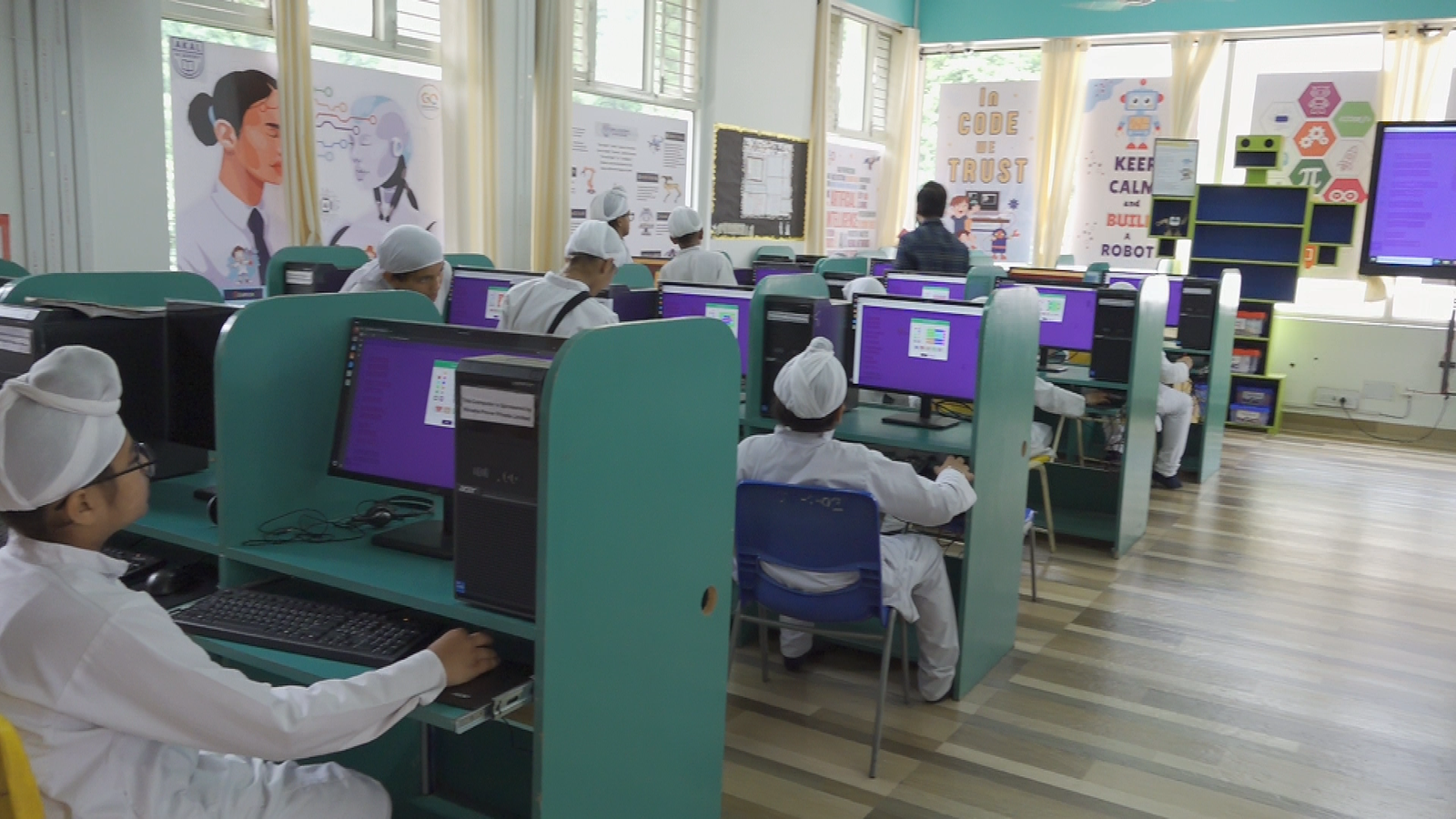
| Middle | 6–8 | Computer Lab with 15+ workstations. AI tools, data analysis software, no-code AI platforms. Free & open-source encouraged. | 100 hrs |
Pedagogy Requirements
CBSE explicitly moves away from rote learning. Required pedagogical approaches include:
- Hands-on activities, games, and puzzles (not textbook memorization)
- Project-based learning with real-world AI tools
- Interdisciplinary projects combining CT + AI across Maths, Science, Social Studies
- Group discussions and debates on AI ethics and digital citizenship
- Competency-based assessment: reflective journals, practical exams, thematic projects
- No-code AI tools: image classifiers, chatbots, data prediction apps
- Data collection, organization, visualization using digital tools
The 5 Reasons CBSE Designed This Curriculum
The document articulates five explicit rationales. Understanding these helps schools make the case to management, parents, and government bodies:
1. Future Readiness
Modern jobs require data literacy, pattern analysis, and ethical AI use. CT & AI equip students for the world of work in technology-driven societies.
2. Holistic Development
CT develops logical reasoning, creative problem-solving, and ethical decision-making — not just coding skills. It creates responsible digital citizens.
3. Interdisciplinary Learning
CT connects Maths, Science, Humanities, and Technology. Students see knowledge as interconnected, not compartmentalized — a core NEP 2020 goal.
4. Innovation & Entrepreneurship
Problem-solving, innovative thinking, and recreating human processes through AI builds an entrepreneurial mindset from early schooling.
5. Ethical Awareness
Students learn about AI bias, fairness, inclusivity, privacy, and responsible technology use — making them thoughtful digital citizens, not passive consumers.
Bonus: AI Readiness Index
India’s NEP goal: emerge as a global leader in AI. This curriculum directly builds the pipeline — from CT foundations in Grade 3 to full AI project work in Grade 8.
How GoGlobalWays Delivers This — Right Now
GoGlobalWays is not playing catch-up with this curriculum. As an AI-powered Composite Skill Lab and K–12 EdTech knowledge partner, our programs are already aligned with every key requirement the CBSE CT & AI curriculum mandates.
India’s schools are at an inflection point. The National Education Policy (NEP) 2020 has set an ambitious goal: make India a global leader in Artificial Intelligence, Machine Learning, Data Science, and Computational Thinking. And now, CBSE has translated that policy into action with its official Computational Thinking and Artificial Intelligence (CT & AI) Curriculum for Classes 3 to 8, released for Academic Year 2026–27.
| CBSE Requirement | GoGlobalWays Delivery |
|---|---|
| CT embedded in Class 3–5 subjects | Structured activity books and worksheets for Grades 3–5 aligned to CBSE Mathematics and TWAU |
| AI Literacy for Class 6–8 | Dedicated AI, Machine Learning, and Data Science modules for Grades 6–8 with no-code tools and real-world projects |
| 100 hrs/year for Grade 6–8 | Full session planning covering 40 hrs CT, 20 hrs AI, 40 hrs interdisciplinary projects — turnkey timetable provided |
| Competency-based assessment | 3Cs Impact Assessment Report Card — proprietary assessment system covering Conceptual, Computational, and Creative competencies |
| Ethics & digital responsibility | Integrated AI Ethics and Digital Citizenship modules in every program |
| Interdisciplinary projects | STEAM-based project modules connecting Science, Maths, Language, and AI tools |
| No-code AI tools for Grade 8 | Image classifiers, chatbot builders, and data prediction tools included in Grade 8 curriculum |
| Teacher training | Dedicated teacher training and trainer support — subject teachers + AI trainer model aligned to CBSE’s collaborative delivery model |
What Schools Need to Do — A Practical Action Plan
If you are a school principal, HOD, or academic coordinator, here is a realistic roadmap to achieve full CBSE CT & AI curriculum compliance for 2026–27:
- Audit current capacity: Do you have a Computer Lab with 15+ workstations? Do your teachers have any AI/CT training? Are Class 3–5 Maths and TWAU teachers aware of the new CT requirement?
- Plan infrastructure: For Grade 6–8, you need a functional AI/Computer Lab. GoGlobalWays Composite Skill Lab setup covers hardware, software, curriculum, and trainer — end-to-end.
- Train teachers: CBSE mandates collaborative teaching (subject teachers + Computer teacher). Both groups need orientation. GoGlobalWays teacher training programs cover this explicitly.
- Select curriculum materials: CBSE allows school choice of platform. Choose a partner whose materials are structured, CBSE-aligned, NEP 2020-compliant, and come with clear session plans.
- Implement assessment reform: Move from marks-based to competency-based assessment. GoGlobalWays 3Cs Report Card system is designed for this transition.
- Start with Grade 6: If full-school rollout feels overwhelming, pilot in Grade 6 first — the AI syllabus is foundational and the infrastructure investment is manageable.
The Bottom Line
CBSE’s Computational Thinking and AI Curriculum for Classes 3–8 is not a distant aspiration — it is the academic year 2026–27 mandate. Schools that treat this as optional risk falling behind not just in compliance, but in the quality of education they deliver to students who will spend their careers in an AI-driven world.
The curriculum is thoughtfully designed: it builds CT foundations in early grades, introduces genuine AI literacy in the middle school years, and requires hands-on project work, ethical reasoning, and competency-based assessment throughout. It demands more from schools — better infrastructure, better-trained teachers, better curriculum materials.
GoGlobalWays exists to bridge exactly this gap. As a K–12 EdTech knowledge partner — not a hardware vendor, not a book publisher — we bring the full ecosystem: curriculum aligned to CBSE, NSQF, and NEP 2020; AI-powered Composite Skill Labs; trained instructors; and the only assessment system in the market designed specifically for 21st-century skill measurement.
Ready to Set Up a CBSE-Aligned AI Skill Lab?
Talk to our curriculum team. We’ll map your school’s current state against CBSE CT & AI requirements and design an implementation plan that fits your budget, timeline, and infrastructure.
📞 Call Us: 8882330300